
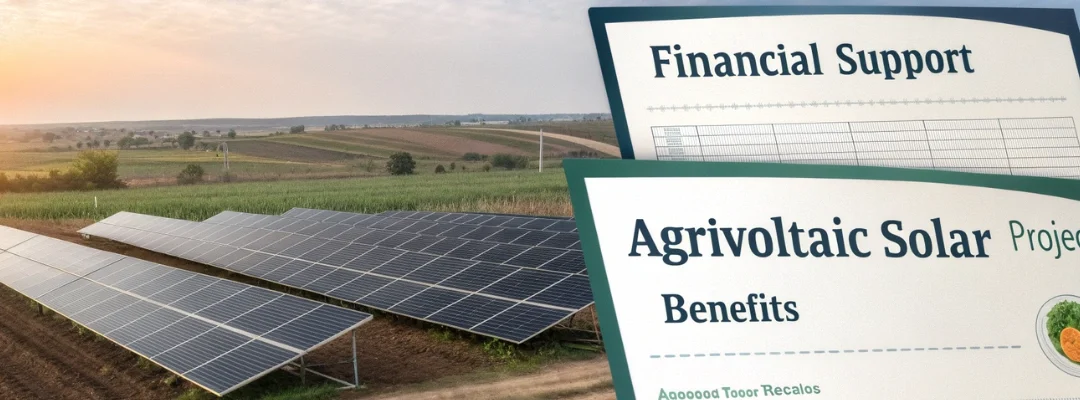
Agrivoltaics — the dual-use of farmland for agriculture and solar power generation — is gaining momentum across Karnataka. With unpredictable weather patterns and rising input costs, farmers are looking for stable, sustainable income sources.While Karnataka doesn’t have a dedicated agrivoltaics policy for 2026 yet, it actively supports the model through central and state programs. These include PM-KUSUM at the national level and Surya Raitha Scheme at the state level, enabling farmers to reduce energy costs and sell surplus solar power for passive income.
Central Government Support: PM-KUSUM
The Pradhan Mantri Kisan Urja Suraksha evam Utthaan Mahabhiyan (PM-KUSUM) promotes solar energy adoption in agriculture. It includes three core components:
Grid-Connected Solar Power Plants (Component A)
Farmers can install solar plants (500 kW–2 MW) on unused land and sell electricity to local DISCOMs.
- Incentive: DISCOMs receive ₹0.40 per unit for 5 years.
- Agrivoltaic Advantage: Elevated panels allow crops like pulses, turmeric, and leafy greens to thrive beneath.
Standalone Solar Pumps (Component B)
Solar pumps provide reliable, off-grid irrigation, reducing diesel and power grid dependence in rural areas.
Solarization of Grid-Connected Pumps (Component C)
This supports converting existing electric pumps to solar-powered ones, enabling farmers to use solar for irrigation and export surplus energy.
Financial Assistance Breakdown
PM-KUSUM follows a cost-sharing model:
- 30% subsidy from MNRE
- 30% subsidy from the Karnataka Government
- 30% bank loan
- Only 10% farmer contribution
This ensures affordability for small and marginal farmers.
State-Level Agrivoltaic Programs in Karnataka
Karnataka supports solar agriculture through tailored state schemes.
Surya Raitha Scheme (KREDL)
Managed by Karnataka Renewable Energy Development Limited (KREDL), this scheme promotes solarization of irrigation pumps. Farmers can use solar energy for irrigation and sell excess electricity to the grid.
Enhanced PM-KUSUM Support in Karnataka (2026 Update)
In 2026, Karnataka increased subsidies for Component B (Standalone Solar Pumps) to cover up to 50% of project cost, reducing the farmer’s out-of-pocket expense to just 20% after loans. This is especially helpful in water-stressed districts like Chitradurga, Koppal, and Kalaburagi.
Land Conversion Fee Exemption
Karnataka waives land conversion charges for solar projects on farmland — reducing legal barriers and enabling faster adoption.
Step-by-Step: How to Apply for Agrivoltaic Subsidies
Farmers and cooperatives can follow this simple process to benefit from available grants and subsidies:
1.Contact the Nodal Agency:
Visit your district’s KREDL office or the Department of Agriculture for guidance.
2.Online Application:
Apply through the MNRE PM-KUSUM portal or the KREDL website for state-specific schemes.
3.Prepare Required Documents:
- Aadhaar and address proof
- Land ownership documents
- Bank account details
- Project quotation from an empanelled vendor
4.Vendor Selection:
Choose an MNRE/KREDL-approved solar installer to ensure quality standards.
5.Inspection and Subsidy Transfer:
After installation and verification, the subsidy is directly credited to the farmer’s bank account.
Why Agrivoltaics Work for Karnataka Farmers
Farmers in semi-arid and irrigation-dependent zones of Karnataka have already started to see measurable benefits:
- Reduced water evaporation: Solar panels create shade that preserves soil moisture.
- Improved crop yields: Crops like vegetables and millets thrive under partial shade.
- Stable income: Solar power sales offer consistent revenue even during poor crop seasons.
Many early adopters have recovered their investment within 5 to 7 years, after which they enjoy free power and additional income for over two decades.
Government Backing & Long-Term Vision
Karnataka’s proactive participation in PM-KUSUM and Surya Raitha showcases its commitment to renewable energy integration in agriculture.With increasing financial support and simplified land-use rules, the state aims to make every farm energy self-sufficient by 2030.The collaboration between KREDL, MNRE, and local banks ensures that solar energy adoption continues to scale rapidly across both small and large farmlands.
Why Farmers Should Adopt Now
Agrivoltaics are not just about sustainability — they are about financial resilience and independence.By taking advantage of these government-backed schemes, farmers can secure:
- Predictable long-term income
- Lower operational costs
- Sustainable water and energy use
- Contribution to India’s net-zero carbon goals
All subsidies are disbursed through verified government channels, ensuring transparency and accountability.