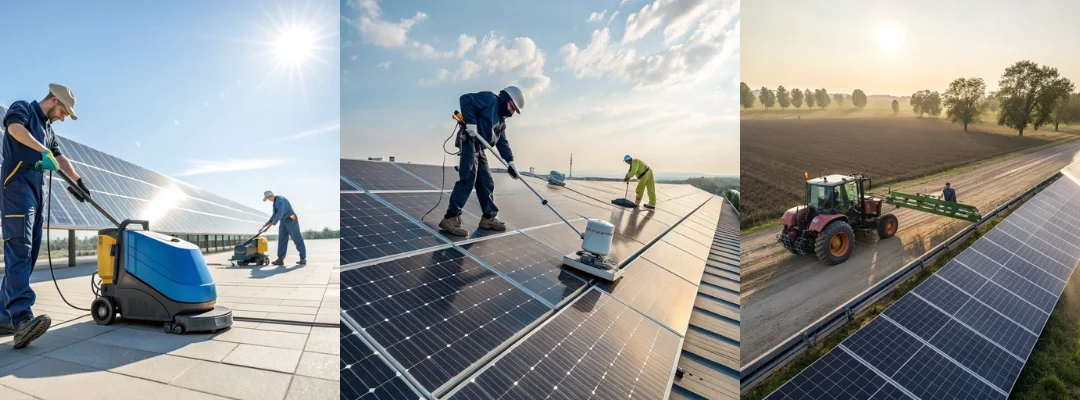
Maintaining the efficiency of solar panels is crucial for maximizing energy output and ensuring longevity. In regions like Bangalore, where seasonal variations can impact panel performance, selecting the appropriate cleaning method is essential. This blog delves into the advantages and limitations of three primary solar panel cleaning approaches: cleaning tractors, robots, and manual methods.
Key Reasons for Regular Cleaning
Maximizes Energy Output
- Dirt, dust, and grime block sunlight from reaching solar cells, reducing the system’s power generation.
- Clean panels operate at peak efficiency, ensuring your solar system delivers the expected energy yield.
Extends Lifespan
- Regular maintenance prevents corrosion, wear, and mechanical damage, protecting your long-term investment.
- Well-maintained panels can last 25 years or more, providing decades of clean energy.
Improves Return on Investment (ROI)
- Higher energy production directly translates to greater cost savings.
- Consistent cleaning ensures faster payback periods and maximizes the lifetime financial benefits.
Reduces Repair and Replacement Costs
- Detecting issues early—such as cracks, loose wiring, or corrosion—prevents major failures.
- Routine upkeep minimizes unexpected downtime and repair expenses.
Maintains Year-Round Performance
- Seasonal cleaning tailored to summer, monsoon, and winter ensures continuous energy production
- Panels stay resilient against dust storms, rainfall, and seasonal environmental changes.
Enhances Environmental and Sustainability Benefits
- Efficient panels generate more clean energy, reducing reliance on fossil fuels.
- Supports sustainability goals and improves the eco-friendly credentials of your home, warehouse, or farm.
Solar Panel Cleaning Tractors
Overview: Tractor-mounted cleaning systems are designed to efficiently clean solar panels using hydraulic-powered brushes and water systems. It comes under the of semi-automated
Key Advantages:
- High Efficiency: Capable of cleaning the entire panel length in a single pass, covering approximately 1,500 to 2,000 panels per hour.
- Versatility: Suitable for both wet and dry cleaning, effectively removing dust, bird droppings, and sticky residues.
- Operational Flexibility: Can be operated during low-light conditions and require only a single operator.
- Water Conservation: Utilizes 2,000 to 4,000 liters of water per MW, significantly less than manual cleaning methods.
Considerations:
- Infrastructure Requirements: Requires vehicle access between panel arrays.
- Initial Investment: Higher upfront cost compared to manual methods.
Solar Panel Cleaning Robots
Overview: Autonomous robotic cleaners equipped with brushes and sensors are designed for dry cleaning of solar panels.
Key Advantages:
- Automation: Reduces labor costs and human intervention.
- Portability: Lightweight and can be moved between panels.
- Low Water Usage: Ideal for dry regions due to minimal water requirements.
Considerations:
- Limited Wet Cleaning Capability: Most models are restricted to dry cleaning due to electrical components.
- Energy Dependency: Some models rely on solar power, limiting operation during cloudy conditions.
- Maintenance Needs: May require more frequent servicing compared to tractors.
Manual Cleaning
Overview: Involves human labor using soft brushes, sponges, and water to clean solar panels.
Key Advantages:
- Low Initial Cost: Minimal investment required.
- Flexibility: Can access panels in areas without vehicle access.
- Suitable for Small Installations: Ideal for residential or small-scale setups.
Considerations:
- Labor-Intensive: Requires a significant workforce, with up to 15 people needed for large-scale cleaning.
- Time-Consuming: Approximately 6 to 8 hours needed to clean 1 MW of panels.
- High Water Usage: Consumes 10,000 to 15,000 liters of water per MW.
- Inconsistent Results: Cleaning quality can vary based on individual performance.
Comparative Overview
| Feature | Cleaning Tractors | Cleaning Robots | Manual Cleaning |
| Cleaning Efficiency | 95–99% | 70–85% | 85–99% |
| Bird Dropping Removal | 90–99% | 0% | 85–95% |
| Time per MW | 2 hours | 3 hours | 6–8 hours |
| Panels Cleaned per Hour | 1,500–2,000 | 1,000–1,350 | 350–500 |
| Water Usage per MW | 2,000–4,000 liters | Minimal | 10,000–15,000 liters |
| Labor Requirements | 1 operator | 2 operators | 10–15 workers |
| Nighttime Operation | Yes | No | No |
| Maintenance Needs | Low | High | Not applicable |
Choosing the Right Cleaning Method
- For Large-Scale Solar Farms: Cleaning tractors offer high efficiency, reduced labor costs, and are suitable for various weather conditions.
- For Rooftop Installations: Robotic cleaners provide a balance between automation and space constraints.
- For Small-Scale or Residential Systems: Manual cleaning remains a cost-effective solution, though it demands more time and labor.