In today’s energy-intensive economy, strategic power sourcing is mission-critical. For Bangalore’s IT parks and manufacturing hubs, solar Power Purchase Agreements (PPAs) are emerging as a game-changing solution. With surging utility tariffs, rising ESG pressure, and limited in-house energy infrastructure, businesses are choosing PPAs to reduce cost, enhance sustainability, and avoid capital expenditure.
Under a solar PPA, a third-party developer installs and operates the solar system on the customer’s site. The business simply pays a fixed per-unit rate for the power consumed—typically much lower than prevailing grid tariffs. With zero upfront cost, performance guarantees, and regulatory support, this model is gaining rapid traction in Karnataka’s commercial-industrial belt.
What Is a Solar PPA?
Definition & Structure
A Solar Power Purchase Agreement (PPA) is a long-term contract in which:
- The developer finances, installs, and operates the solar project.
- The consumer (e.g., a business or industrial unit) purchases the electricity generated.
- The tariff is pre-agreed per unit (kWh), generally fixed or minimally escalated over 10–25 years.
- At the end of the term, the consumer may purchase the asset or extend the agreement.
Why Businesses Opt for PPAs
- Zero CapEx: No upfront investment by the business.
- Predictable Power Cost: Shield from tariff hikes and budget volatility.
- Maintenance-Free: The developer manages O&M, warranties, and performance.
- ESG Alignment: Reduces carbon footprint, improves CSR and green credentials.
PPAs decouple energy benefits from ownership complexity, making them highly attractive for non-energy-intensive organizations seeking savings and sustainability.
Why PPAs Are Ideal for IT Parks & Manufacturing Units in Bangalore
High and Stable Load Profiles
Tech campuses and industrial units operate with stable, high daily loads—ideal for solar offset. PPAs with hybrid battery or grid fallback provide consistent power without disruption.
Tariff Savings & Predictability
Utility tariffs in Karnataka rise 5–7% annually. With PPAs, consumers lock in lower solar tariffs, often 30–50% cheaper than grid power, with predictable multi-year budgeting.
Zero Operational Hassle
No need for in-house solar expertise. The developer handles permits, monitoring, cleaning, and compliance.
Sustainability Positioning
Clients, investors, and regulators are watching ESG closely. A PPA sends a visible signal of climate commitment, especially when disclosed in sustainability reports.
Scalable Across Sites
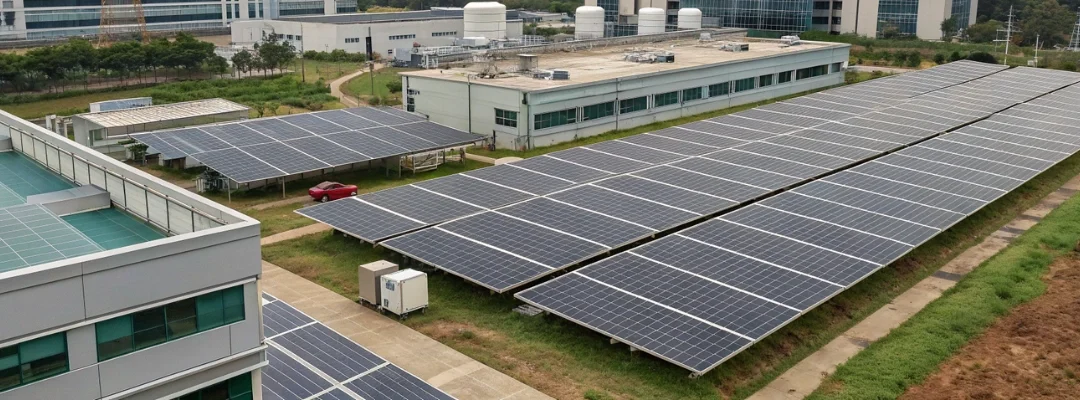
PPA models support both rooftop and ground-mount solutions, with open access enabling supply from offsite plants to multiple facilities.
Real-World Illustrations in Karnataka
| Sector | Capacity | Tenure | Tariff | Result |
| IT Park (Whitefield) | 1 MW rooftop + carport | 15 years | ₹4.25/kWh | 40% cost reduction |
| Manufacturing (Peenya) | 2.5 MW ground-mounted | 20 years | ₹4.80/kWh | Deep savings + ESG gains |
| Logistics/Warehouse | 500 kW rooftop | 12 years | ₹4.10/kWh | Fast ROI, brand visibility |
These projects showcase solar PPA’s commercial feasibility and high impact.
How a Solar PPA Project Unfolds
Step 1: Feasibility Assessment
- Evaluate load profiles, roof/land potential, and regulatory scope.
Step 2: Proposal & Tariff Structuring
- Developer presents design, tariff, and ROI model.
Step 3: Contracting & Compliance
- Agreements define escalation, penalties, and buyout clauses. Permits from BESCOM/KERC secured.
Step 4: System Installation
- Developer handles EPC, testing, and grid sync.
Step 5: Power Supply & Billing
- Energy delivered to internal meters. Monthly invoicing by usage.
Step 6: Ongoing O&M
- Developer ensures uptime, panel cleaning, and remote monitoring.
Financial Benefits & ROI
| Metric | Grid Power | Solar PPA |
| Rate/kWh | ₹8.50–₹10.50 | ₹4.00–₹5.50 |
| Inflation | 5–7%/year | 0–1%/year |
| Upfront Cost | 100% CapEx | 0% |
| Maintenance | Internal | Developer-provided |
Effective IRRs of 15–25% can be achieved. Many projects reach cost crossover within 1–3 years.
Regulatory & Policy Support
Net Metering & Open Access
Karnataka allows net metering and offsite PPAs for eligible C&I users.
State Renewable Energy Policy
Supports captive and third-party solar; promotes wheeling and banking.
Incentives
Group captive and rooftop systems may access benefits under RPOs or local schemes.
Choosing the Right PPA Partner
Look for:
- Proven installations across industrial segments
- Technical strength: Engineering, monitoring, O&M
- Transparent terms: Tariff, penalties, exit clauses
- Financial health: Ability to deliver long-term value
- Support with regulatory approvals
Challenges & Mitigation
| Challenge | Solution |
| Roof/load constraints | Use hybrid carport or offsite models |
| Tariff/legal risks | Insist on clear, expert-drafted contracts |
| Payment risk | Use escrow/guarantee mechanisms |
| Regulatory delays | Partner with experienced solar facilitators |
By planning for these risks, businesses can de-risk their solar transition while unlocking major cost and climate benefits.